What Bakersfield Businesses Should Look for in a Marketing Agency
Not all Bakersfield marketing agencies are equal. Learn what separates a true local partner from a templated national page -- and how to choose wisely.
Finding the right marketing partner can make or break your business growth in today's competitive landscape. For local business owners in California's Central Valley, choosing the right marketing agency Bakersfield has to offer is one of the most important decisions you will make for your company's future.
But here is the problem: not all marketing agencies are created equal. Some promise big results but fail to deliver. Others may lack the local knowledge needed to truly connect with Bakersfield's unique market and community. As a business owner just starting to explore your marketing options, navigating this process can feel overwhelming.
That is exactly why we created this guide. Whether you run a small retail shop, a local restaurant, or a growing service-based business, this list will walk you through the key qualities and factors you should look for before signing any contract. By the end, you will have a clear, confident understanding of what separates a great local marketing agency from one that will waste your time and budget. Let's get started.
Local Presence vs. a Local Landing Page
When you search for a marketing agency in Bakersfield, the results can be deceiving. Several national agencies have built dedicated Bakersfield landing pages designed to rank for local searches, but a polished city page is not the same as genuine local presence. A templated page that swaps ZIP codes and drops in the word "Bakersfield" a dozen times tells you nothing about whether that agency understands your market, your customers, or your competition. In some cases, those pages do not even hold up under scrutiny; the dedicated Bakersfield page from one nationally promoted agency returned a 404 error at the time of research, which is a telling example of how thin that local commitment really is.
According to Clutch, 54 agencies are currently competing for Bakersfield digital marketing visibility as of August 2026. That number sounds impressive until you realize that a significant portion of those listings represent out-of-market agencies targeting the city with location pages, not teams with boots on the ground in Kern County. True local embeddedness is far rarer than the search results suggest.
What separates a real Bakersfield agency from a city-page play comes down to specific market knowledge. Bakersfield's economy runs on oil and gas, agriculture, and logistics; Kern County is California's largest crude producer, leads the nation in farm-gate value, and sits at a key Western distribution corridor. A Bakersfield agency also understands that bilingual marketing matters here in ways a coastal agency will consistently underestimate. Research on local versus national agency trade-offs confirms that hyper-local SEO and culturally tailored strategy are structural advantages local firms hold, not just a talking point.
Here is a simple qualifying test: ask any prospective agency to name the top three industries driving Bakersfield's economy. Hesitation tells you everything you need to know.
Wolfpack Marketing operates in Bakersfield, serves Bakersfield businesses, and builds every strategy around the realities of this specific market. That is not a national playbook with your city name inserted; it is the difference between a template and actual expertise.
Full-Service Integration vs. Piecemeal Vendors
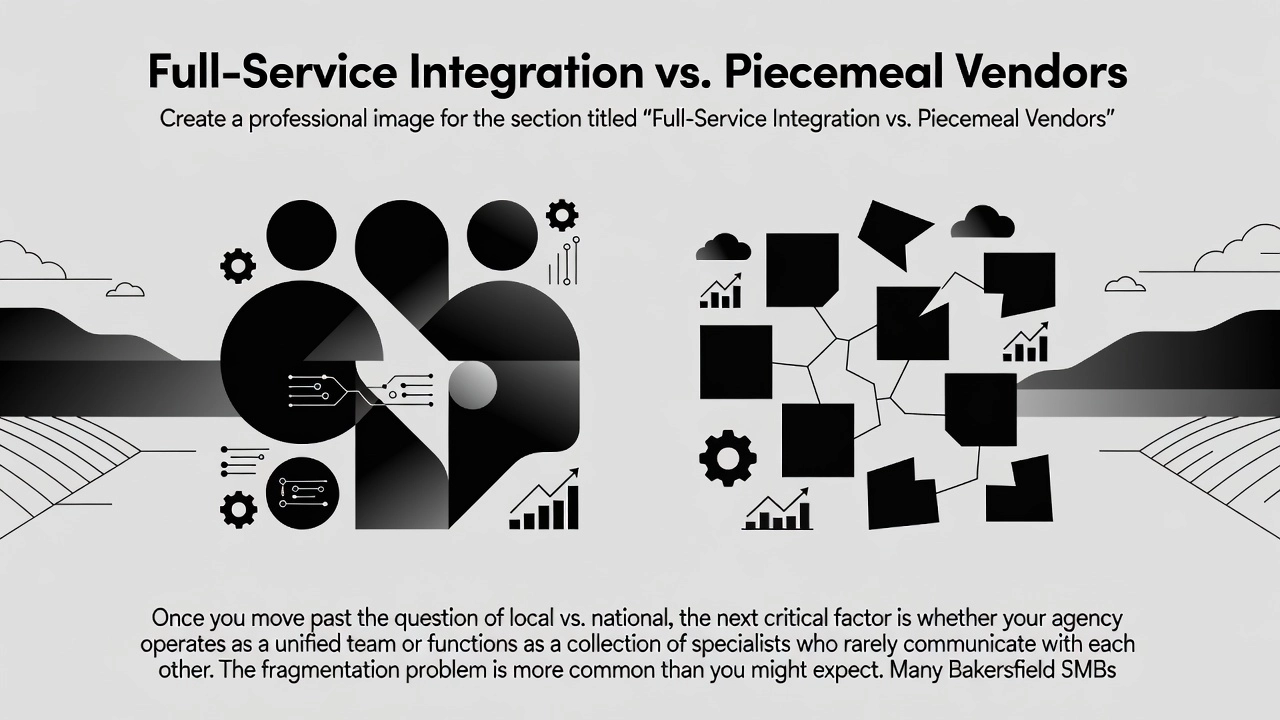
Once you move past the question of local vs. national, the next critical factor is whether your agency operates as a unified team or functions as a collection of specialists who rarely communicate with each other.
The fragmentation problem is more common than you might expect. Many Bakersfield SMBs build their marketing stacks piece by piece: one vendor handles SEO, another builds the website, a third manages social media, and a fourth runs paid ads. On paper, each vendor looks qualified. In practice, this arrangement creates three persistent problems: misaligned strategies, duplicated overhead, and accountability gaps. When leads dry up, the SEO vendor points to poor ad targeting, the PPC vendor blames the landing page, and the web designer questions traffic quality. No one owns the full funnel, and you end up paying for activity rather than outcomes.
Integration changes what becomes possible across every channel. When paid media, SEO, web design, and social media operate under one roof, data flows freely between them. A paid search campaign reveals which keywords and audience segments are actually converting, and that intelligence directly shapes SEO content priorities. Web design decisions get made with conversion rate optimization in mind from the very first wireframe, rather than as an expensive retrofit after a campaign underperforms. According to industry research from Promethean Research, more than 87% of North American digital agencies employ fewer than 50 people, and the vast majority are single-channel specialists. This supply-side fragmentation is a direct driver of piecemeal buying behavior among local businesses.
Unified reporting is the most practical test of whether integration is real. Siloed vendors produce siloed dashboards. The social media vendor shows engagement metrics; the SEO vendor shows keyword rankings; the PPC vendor shows impressions and click-through rates. None of these reports connect, and none of them answer the only question that matters: is any single marketing dollar actually driving revenue? Transparent analytics covering traffic, conversions, ad performance, and social engagement are only possible when all channels feed a single reporting system. As the August 2026 Clutch rankings for Bakersfield digital marketing agencies make clear, the local market has 54 competing agencies, yet integrated full-service providers with genuine reporting depth remain rare.
The connective tissue of a true full-service engagement is unified measurement. You should be able to trace any lead from the first ad impression through to a closed deal, and your agency should surface that data for you proactively, not just on request. When Wolfpack Marketing manages your SEO, paid media, web presence, and social channels together, every data point informs every other channel, and your reporting reflects what your business actually earned, not what each vendor chose to highlight.
Industry Expertise: Bakersfield Is Not a Generic Market
Beyond the question of local presence and service integration, there is a third filter that separates genuinely useful agency partners from expensive mismatches: vertical expertise. Bakersfield is not a scaled-down version of Los Angeles or a generic mid-sized market. It is one of the most economically distinct metros in California, and marketing here demands a different playbook depending on what industry you are in.
Kern County is California's largest crude oil producer and a national leader in farm-gate agricultural value, making this region unlike virtually any other market in the American West. Those two industries alone create a B2B marketing landscape shaped by procurement cycles, regulatory compliance messaging, safety and environmental positioning, and seasonal budget windows. Marketing an oilfield services firm requires fluency in the language of HSE compliance, contract bidding, and industrial buyer behavior. Marketing an almond or pistachio operation means understanding harvest-driven spending cycles and the realities of commodity pricing pressure. Neither of those assignments has anything in common with a direct-to-consumer retail campaign, and agencies that treat them interchangeably will consistently underdeliver.
The broader Bakersfield metro generated a $54.1 billion GDP in 2024, according to the Bureau of Economic Analysis (December 2025 release). That economic output is anchored by four verticals: oil and gas, agriculture, logistics, and healthcare. Each of those sectors operates on a fundamentally different buyer journey timeline, with different decision-makers, different trust signals, and different seasonal patterns that directly affect when and how you should invest in paid and organic marketing.
Geographic targeting within Bakersfield adds another layer of complexity that outside agencies routinely miss. A healthcare practice targeting patients in Southwest Bakersfield is working with a consumer audience defined by specific income profiles, insurance access, and language preferences. A logistics company pursuing B2B contracts in the industrial corridor near Highway 99 is selling to procurement managers on contract renewal schedules. These are structurally different targeting problems, and conflating them produces wasted ad spend and messaging that fails to convert.
Coastal-focused national agencies also tend to underestimate bilingual consumer demand in markets like Bakersfield. Agricultural communities across Kern County include substantial Spanish-dominant populations, and a single-language digital campaign will structurally underperform in paid media reach, local search relevance, and consumer trust in those segments. This is a high-ROI gap that agencies without real local knowledge consistently leave on the table.
Before signing any agency contract, ask for demonstrable experience in your specific vertical. A case study from a retail brand in Austin does not qualify as relevant experience for an oilfield services company in Kern County. Request examples from your actual industry, in markets with comparable B2B or bilingual complexity, with results you can verify. Generic capabilities decks are not a substitute for earned vertical knowledge.
AI Search Visibility Is Now Part of the Job
There is a fourth dimension to agency evaluation that most Bakersfield business owners have not yet considered, and it is rapidly becoming non-negotiable. Ranking on the first page of Google is still important, but in 2026 it is no longer the complete picture. A growing share of purchase research now begins inside AI-powered tools like ChatGPT, Perplexity, Gemini, and Google AI Overviews. These platforms do not show users a list of links to click. They generate direct answers, synthesized summaries, and specific recommendations, often without the user ever visiting a traditional search results page. ChatGPT alone handles over 800 million monthly searches, and Perplexity AI is growing at 40% month over month. If your business is absent from those AI-generated answers, you are invisible to that segment of buyers entirely.
This is not a trend to watch for next year. Generative Engine Optimization (GEO) and Answer Engine Optimization (AEO) are already transitioning into expected agency deliverables. Forward-looking agencies competing in the Bakersfield market have begun marketing these services explicitly on their local-facing pages, which means the businesses working with those agencies are already building AI search presence while others are not.
Understanding why requires knowing how AI search tools work differently from traditional search engines. Standard algorithms rank pages based heavily on links and keyword signals. AI systems instead evaluate topical authority, content structure, brand credibility across the web, and how easily a model can extract a clear, attributable answer from your content. Keyword-stuffed pages score poorly in this environment. Clearly structured, locally specific, authoritative content scores well. A Bakersfield HVAC company or agricultural supplier with well-organized service pages and consistent citations across credible sources stands a far better chance of appearing in AI-generated answers than a competitor with a technically optimized but thin website.
The practical consequence is what researchers call the invisible business problem. A business can hold a first-page Google ranking and still be completely absent from the synthesized answers that an increasing number of buyers consult before making a purchase decision. If your brand does not appear in that synthesis, a competitor who does holds a meaningful narrative advantage, not just a visibility advantage.
When evaluating any marketing agency in Bakersfield, ask this question directly: what is your specific strategy for improving our visibility in AI-generated search results? A strong answer should reference content structuring for AI citation, entity recognition, structured data implementation, and AI visibility tracking across platforms. According to research into leading GEO service providers, a complete AI search strategy encompasses citation analysis, competitor benchmarking, technical optimization, and clear ongoing reporting. If the agency responds with a vague answer or pivots back to traditional SEO metrics only, that is a measurable gap in their service model, and one worth taking seriously before signing a contract.
Bilingual Marketing: The High-ROI Gap Almost Every Agency Ignores
Bakersfield is one of the most Hispanic-majority mid-size cities in California, with Hispanic residents comprising approximately 50% or more of the total population according to U.S. Census Bureau data for Kern County. That demographic reality creates one of the clearest high-ROI marketing opportunities in the entire local market, and it is almost entirely unclaimed. National agencies targeting Bakersfield with templated landing pages are not building Spanish-language content strategies. Most local agencies have not invested in genuine bilingual capabilities either. The result is a wide-open competitive environment where businesses willing to invest in authentic Spanish-language digital marketing face almost no competition for audience attention.
The critical distinction here is that effective bilingual marketing is not a translation exercise. Running your existing English ads through Google Translate and posting them on Facebook does not constitute a bilingual strategy; it constitutes a missed opportunity at best and a brand credibility problem at worst. Reaching Spanish-speaking consumers in Bakersfield requires cultural fluency, platform-specific execution, and messaging that resonates on a human level. Spanish-language Facebook targeting, for example, allows advertisers to reach specific audience segments with creative that feels native rather than imported. As research into Hispanic digital advertising trends confirms, "to truly connect with Hispanic audiences, advertisers must embrace digital-driven solutions that are not just technically advanced, but culturally coherent." Generic or poorly adapted messaging signals to consumers that a brand does not actually understand them.
The industries with the most to gain are also some of Bakersfield's most economically significant sectors. Agriculture, construction, healthcare, and consumer services all employ and serve large Spanish-speaking populations locally. A healthcare clinic that communicates fluently with Spanish-speaking patients, or a construction company that markets directly to bilingual crews and subcontractors, earns trust that competitors advertising only in English simply cannot access. The U.S. Latino market now represents a $3.6 trillion GDP growing at 4.6% annually, making this audience a genuine economic priority rather than a secondary consideration.
Businesses that move into this space now will earn brand loyalty that late movers cannot buy at any price. First-mover advantage in underserved communities compounds over time as recognition and trust build, and those relationships are not easily disrupted once established. This is a content gap the Bakersfield market has not yet seen addressed at scale, and the window for capturing it remains open today.
Transparent Reporting: You Should Know Where Every Dollar Goes
Detailed, honest reporting is one of the clearest signals that an agency is confident in their work. When a monthly report leads with impressions, follower counts, and page views, that is a warning sign, not a performance update. These figures are called vanity metrics for a reason: they look impressive in isolation but tell you almost nothing about whether your marketing investment is generating leads, customers, or revenue. According to research on marketing agency performance metrics, businesses that receive vague reports consistently struggle to connect marketing activity to actual business outcomes like customer acquisition and profit growth.
Good reporting has a minimum standard. At a baseline, your agency should be delivering clear visibility into organic traffic trends, conversion rates broken down by channel, paid media cost-per-lead and return on ad spend (ROAS), and social engagement metrics tied to leads or revenue rather than likes. The key methods agencies use to measure ROI also include Customer Acquisition Cost (CAC) and Lifetime Value (LTV), with a healthy LTV-to-CAC ratio sitting at 3:1 or better for sustainable growth. Without these figures, you are essentially taking your agency's word for results rather than evaluating evidence.
Before signing any contract, ask the agency for a sample report. A well-structured report tells a story: what worked last month, what was adjusted, and why those adjustments were made. It distinguishes between activity data (posts published, ads launched) and outcome data (leads generated, revenue attributed). If the sample report is mostly charts without narrative context, or if the agency hesitates to provide one, treat that as a serious red flag. Agencies that resist detailed reporting are often concealing underperforming campaigns, inflating vanity figures, or running activity that does not connect to your actual business goals.
Wolfpack Marketing builds its client relationships around the opposite principle. Bakersfield businesses working with Wolfpack receive detailed analytics covering traffic, conversions, ad performance, and social engagement, specifically so every decision is grounded in data. That level of transparency is not just a service feature; it is accountability in practice.
What Integrated Marketing Investment Actually Looks Like
Understanding the actual numbers behind marketing investment helps Bakersfield business owners make smarter decisions rather than reactive ones.
A professionally built website for a Bakersfield small business in 2026 ranges from $0 to $50 per month for DIY tools like Wix or Squarespace, up to $5,000 to $20,000 or more for custom professional development. That investment buys you infrastructure. It does not buy you visibility, leads, or revenue. A website without traffic strategy is a storefront with no foot traffic, and many local businesses make the mistake of treating web development as the finish line rather than the starting point.
The piecemeal vendor approach is where budgets quietly spiral. When a Bakersfield business hires a separate SEO freelancer, a social media contractor, and a PPC vendor, each billing independently, the combined monthly spend approaches or exceeds what a full-service integrated retainer would cost. According to current agency retainer pricing data, most business owners sign agreements without understanding what outcomes they are actually purchasing. The deeper problem is not just the cost; it is that three disconnected vendors each optimize for their own channel metrics, with no unified strategy tying their work to your actual business goals.
The more productive question is not "how much does a marketing agency cost?" but rather "what does it cost to become the category leader in my industry in Bakersfield?" Those two questions lead to fundamentally different decisions. According to 2026 digital marketing pricing research, the median monthly integrated retainer sits around $3,000, with full-service engagements ranging from $3,500 to $15,000 or more depending on scope and market competitiveness.
Integrated retainers earn their value through compounding. When SEO, paid media, social, and web are managed under a single strategy, content produced for organic search fuels paid ad copy, paid campaign data sharpens organic targeting, and every channel feeds a website built to convert. That amplification effect is structurally unavailable to businesses running siloed vendors. As content marketing pricing analysis confirms, bundled integrated engagements are specifically designed to create cross-channel lift that individual specialists cannot replicate independently.
Before signing any agency agreement, require a clear breakdown of how each proposed service maps to a specific business outcome, whether that is leads generated, revenue attributed, or market share gained. Any proposal measured primarily in posts published, keywords targeted, or impressions delivered should prompt further questioning. Outcome-oriented agencies welcome that conversation. Activity-focused ones rarely do.
The Real Question: Do You Want to Win Your Category in Bakersfield?
Every factor covered in this guide points toward a single, clarifying question: do you actually want to be the recognized leader in your category in Bakersfield, or are you comfortable with where things stand?
The market makes that ambition financially meaningful. With more than 400,000 residents and a metro economy generating $54.1 billion in GDP, category leadership in almost any local vertical, whether that is healthcare, agriculture, logistics, real estate, or professional services, translates into real revenue at scale. This is not a small town where being the best-known provider earns you a modest advantage. It is a mid-size city with the commercial density to reward dominant positioning significantly.
The competitive window is still open, but it will not stay that way indefinitely. Clutch currently lists 54 agencies competing for Bakersfield digital marketing visibility, yet only one has earned a Leader designation. That ratio tells you the market has not consolidated around dominant players yet. Businesses that build integrated, locally grounded marketing strategies now will compound that authority over the next two to three years, before AI search behaviors solidify, before bilingual content becomes table stakes, and before industry-specific expertise becomes harder to replicate.
Wolfpack Marketing's focus is precisely this: helping Bakersfield businesses become category leaders through SEO, web design, social media, and paid media working together, supported by transparent analytics that show exactly what is driving growth. The next step is a straightforward conversation. Bring your industry, your goals, and your current marketing frustrations, and find out what a category leadership strategy actually looks like for your business specifically.
Conclusion
Choosing the right marketing agency in Bakersfield does not have to feel overwhelming. By focusing on local market knowledge, a proven track record, transparent communication, and services tailored to your specific goals, you can confidently separate the agencies that will deliver real results from those that simply make big promises.
Your business deserves a marketing partner that understands Bakersfield's unique community, speaks to your ideal customers, and grows alongside you. The right agency is not just a vendor; it is a long-term investment in your success.
Now it is time to take action. Use the insights from this guide to evaluate your options, ask the right questions, and choose a partner you can trust. Your next stage of growth is closer than you think. Start the conversation today and take the first step toward marketing that truly works for your business.
Ready for more clicks, calls, and customers?
Let's build a marketing system that hunts leads for your Bakersfield business.